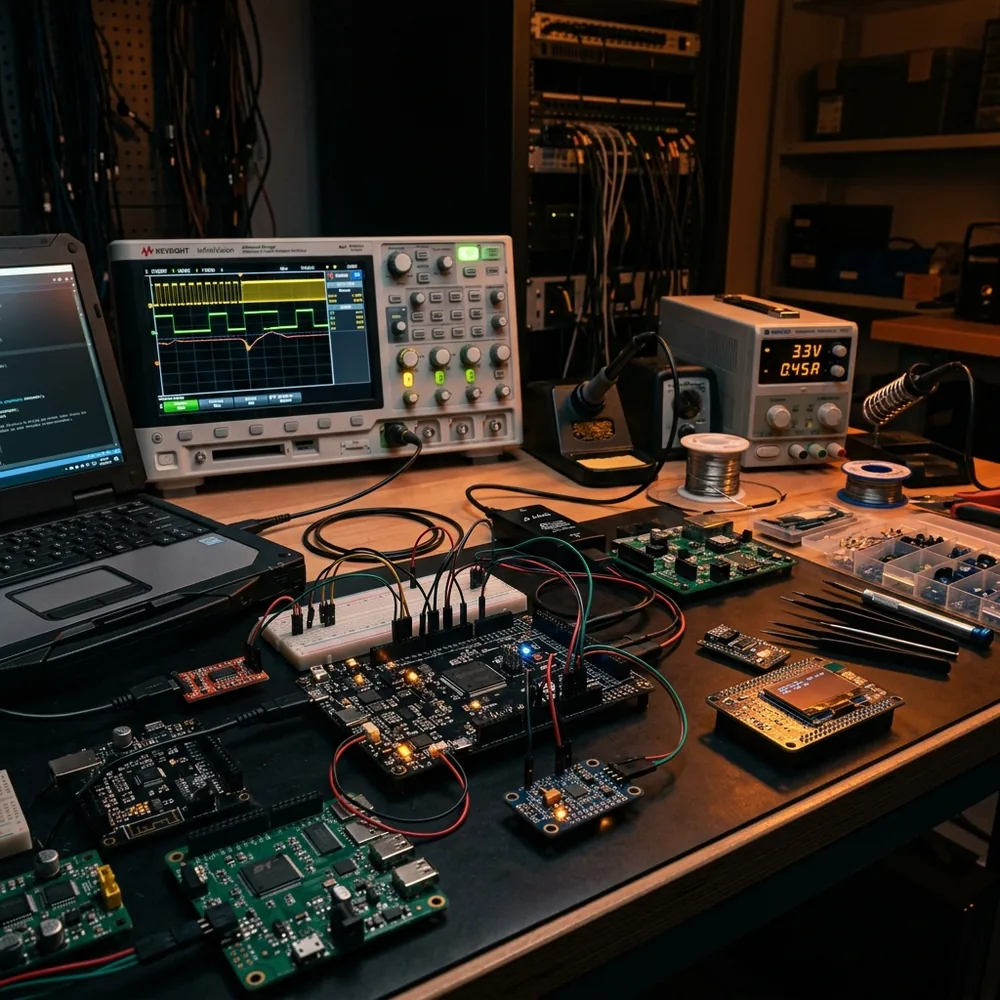
Determinism by Design, Not by Luck
Real-time behaviour is a system property, not a firmware feature. Quantova designs RTOS architecture with timing analysis from the first task definition — deadline analysis, worst-case execution time profiling, and jitter measurement on your target hardware.
Core Services
RTOS Architecture Design (Real-Time OS)
Task decomposition, priority assignment, and scheduling analysis — Rate Monotonic and EDF scheduling with formal deadline verification.
Hard Real-Time Control Loops
PID controllers, motor drive loops, and servo control at deterministic cycle rates — tested with hardware-in-the-loop measurement.
Safety-Critical Firmware
IEC 61508 and ISO 26262-aware firmware design practices — diagnostics, safe state management, and watchdog architecture.
WCET Analysis
Worst-case execution time profiling using hardware cycle counters and RTOS trace tools. Timing budget documented per task.
What You Receive
- RTOS-based firmware source
- Task architecture and timing budget document
- WCET analysis report
- Interrupt latency measurement results
- Safety diagnostic implementation report
Technology Stack
Common Questions
On Cortex-M4 at 168MHz with cache enabled, typical interrupt latency is 12-20 cycles. We profile your specific configuration and document the achieved latency.
We can implement firmware to be certification-aware. We do not act as a certification authority, but we ensure the firmware engineering process and documentation meet the standard requirements your certifier will review.